.svg)
How to Choose a Good Website for Piano Sight Reading Exercises
Sight reading is a foundational skill for pianists, yet finding online resources that genuinely support learning can be challenging. Many websites provide exercises, but not all help learners develop true fluency. Understanding the criteria for effective sight reading practice allows pianists to select platforms that truly enhance skill development.
In practical learning environments, sight reading improvement is rarely linear. Adult learners often report progress appearing in short bursts rather than steady increases, especially when transitioning between difficulty levels. Observations from independent piano instructors and self-directed learners consistently show that regular exposure to unfamiliar but manageable material is more effective than repeating the same patterns for extended periods. This highlights the importance of platforms that support gradual progression while accounting for individual pacing differences.

1. Adaptive Learning Based on Performance
Effective sight reading platforms adjust exercises according to the learner’s skill and performance. Adaptive systems consider accuracy, timing, and consistency, ensuring challenges remain achievable yet stimulating.
Research in music education shows that appropriately scaled challenges improve retention and motivation, while a fixed, one-size-fits-all approach can frustrate learners.. Platforms that track performance and adapt difficulty allow learners to progress efficiently without repeating exercises that are too easy or overwhelming.
For example, MuseFlow uses performance tracking to adjust lesson difficulty dynamically, illustrating how adaptive learning principles can be applied in practice.
2. Real-Time Feedback During Practice
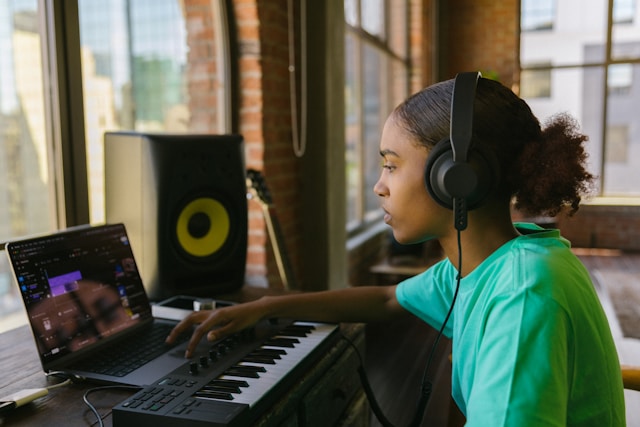
Immediate feedback is critical for sight reading development. When learners receive guidance on mistakes—whether in rhythm, pitch, or timing—they can correct errors immediately instead of reinforcing them over multiple sessions.
This feature is especially helpful for beginners, who may struggle to self-assess while playing. Visual or auditory cues provide clear direction, supporting proper technique and boosting confidence.
Platforms such as MuseFlow demonstrate how real-time feedback can guide independent practice, but the principle applies across any effective learning system.
3. Engagement Without Distraction
Sustained practice depends on maintaining focus and motivation. Engagement doesn’t require excessive gamification; rather, progress indicators, clear goals, and structured challenges help learners stay consistent.
Adult learners particularly benefit from visible improvement and structured routines. These cues reinforce consistency while keeping attention on musical fundamentals rather than novelty.
Some modern platforms include light gamified elements—such as skill milestones or completion tracking—to encourage regular practice while keeping the emphasis on learning rather than entertainment.
4. Varied and Structured Exercise Library
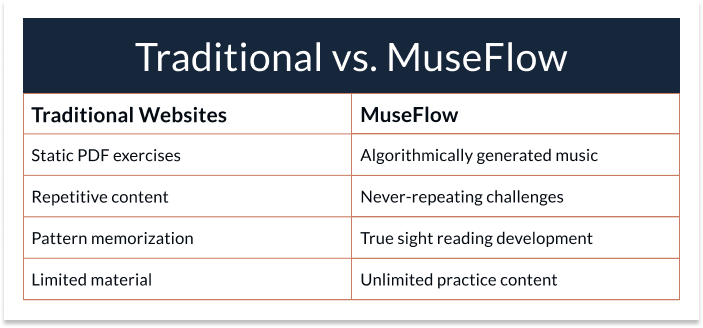
A strong sight reading platform balances structured progression with variety. Curated exercises ensure systematic skill development, while diverse repertoire challenges learners musically and reinforces reading fluency.
Variety helps prevent memorization of patterns and promotes true sight reading ability, including rhythm, pitch, and dynamic accuracy. Platforms that integrate both structured exercises and musical application allow learners to practice in a way that feels both educational and rewarding.
MuseFlow, for instance, combines targeted skill exercises with a rotating repertoire library to illustrate this principle.
5. Flexible Practice to Support Consistency
Consistency is more important than session length. Platforms that support short, flexible practice sessions allow learners to engage daily without scheduling conflicts or rigid routines.
Research in adult learning emphasizes that self-paced control and visible progress improve persistence and retention. Platforms that allow learners to resume exactly where they left off help maintain momentum and reduce frustration.

Clear Learning Intent Improves Sight Reading Progress
Another often overlooked factor is how clearly a platform communicates why specific exercises are assigned. Sight reading improves most effectively when learners understand the purpose behind rhythmic drills, interval jumps, or key changes rather than practicing them mechanically.
Educational research on adult learning consistently shows that transparency in instructional design increases engagement and long-term retention. Websites that briefly explain the skill focus of each exercise help learners practice more intentionally, avoid mindless repetition, and develop transferable reading skills that apply across new musical material.
Bringing It All Together
When evaluating websites for piano sight reading exercises, consider these five criteria:
- Adaptive learning that responds to performance.
- Real-time feedback that enables immediate correction
- Engagement that reinforces motivation without distraction.
- Varied yet structured exercise libraries.
- Flexible practice options to support consistency.
Platforms implement these features differently. MuseFlow is cited here as an example of a system that aligns with these principles, but the framework itself applies broadly across modern sight reading tools.

.jpg)