.svg)
Why Piano Needs to Be in Your Wellness Routine
Sometimes, the beginning of the year can bring stress, anxiety, or other emotional hurdles that we don't expect.
Prolonged stress and anxiety can result in respiratory problems, chronic pain, as well as a number of other issues - on top of just being plain unpleasant to deal with.
Studies show that learning to read and play music may improve mood and reduce depression symptoms.
Researchers discovered that subjects experienced relaxation, happiness, and increased tolerance of uncertainty. Novices to experts were given instruments to play and experienced these benefits over relatively short periods.
If you think about it, it makes sense that tolerance of uncertainty is a benefit of playing music. For one, jazz is highly unpredictable and requires a large amount of improvisation. You never know what’s going to come next. There’s a framework, but what’s being played within that framework is completely up to the other musicians you are playing with. Jazz is inherently uncertain.

How does music reverse the effects of aging?
There were also cognitive benefits in addition to improved mental health, including in aging adults and people with mild brain injuries. Increased dexterity and coordination resulted in an increased quality of life for a diverse group of people.
Music is one of those elements, like smell, that triggers memories in a very visceral way, especially when that memory isn’t able to be tapped into any other way. Unity Hospice summarized it well:
"when a dementia patient hears music connected to a memory, they can 're-awaken' and regain the ability to connect with people around them. Sometimes, people who haven't spoken for years find words and actually sing lyrics."

How does music actually improve mental health?
There are actually a few mechanisms through which playing music improves your wellness.
The multi-sensory workout of playing an instrument improves your executive function because the practice builds the corpus callosum, the area of the brain responsible for emotional regulation and problem solving. It’s a thick bundle of nerves that connect the right and left hemispheres and in musicians, it tends to be more developed. Over time, you can see improvement in executive function and even depression.
This is in addition to the feel-good neurochemical cocktail we get from music: dopamine (pleasure and motivation), oxytocin (the bonding hormone), and a significant drop in cortisol (the stress hormone). This naturally combats stress and anxiety.
How does music training actually improve cognition?
Music training requires complex fine motor skills, as well as increased attention and concentration. While studies reveal an increase in processing speed and improved executive function in both healthy and unhealthy individuals, the exact mechanism is still being studied.
Picking up the piano has been shown to improve cognitive function in mild brain injuries as well as mental illness. There is even a dedicated branch of therapy, known as music therapy, combining clinical research with music to address diagnoses.
What’s the difference between music therapy and music education for wellness?
Music therapy is a structured approach to accomplish a patient’s goals by a credentialed professional. It has been proven to help treat and improve a number of conditions from Parkinson’s to childbirth. It is an extremely beneficial approach that many can benefit from, but it is distinct from an ongoing practice for personal wellbeing and fulfillment.
The same mechanisms that make music therapy effective for treating a wide array of conditions are available to you, too.
Building Your Own Wellness Practice
Learning piano is a skill that you can have for life, can help you become more attentive and less stressed, and you can have fun while doing it! You can take advantage of the physical, emotional, and cognitive benefits and build a personal wellness practice for yourself.
- Start Small: I know these benefits are exciting, but there’s no need to dedicate more than 15-20 minutes of focused piano time to begin to see the benefits.
- Replacement: Choose one habit you’d prefer to replace, such as scrolling social media first thing in the morning, and practice piano instead.
- Habit stacking: Tack your practice onto another habit, and soon it becomes a reflex. As soon as you wash the dishes or finish walking the dog, sit down at the bench!
.png)
Conclusion
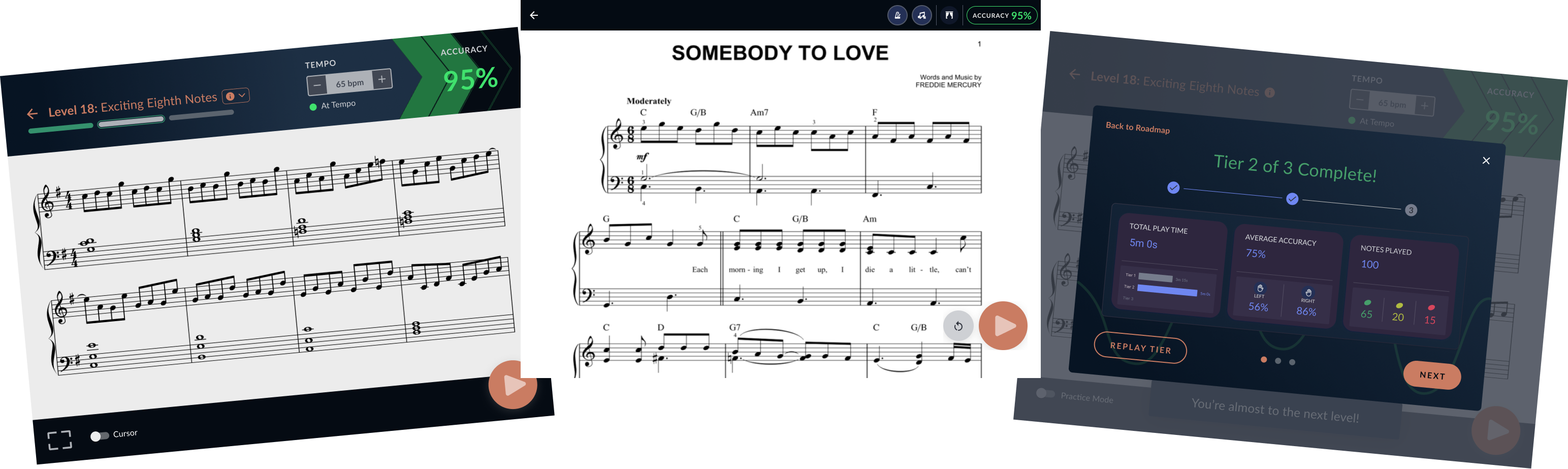
Music learning and wellness go hand in hand. If you’re ready to craft a unique, research-backed wellness practice for yourself, try MuseFlow! Our platform is designed not only for you to learn music in the most effective way possible, but to be engaged and motivated while doing it. MuseFlow is tailored to each pianist, allowing you to enter a Flow State; allowing you to increase skill acquisition, and decrease anxiety and boredom.
Optimize your wellness - try MuseFlow for free today.