.svg)
How Can Traditional Piano Learning Methods Contribute to Focal Dystonia, and What Can We Do About It?
There are perhaps few things scarier to a musician than focal dystonia. I recently had lunch with a friend who is a professional clarinetist for the San Francisco Ballet, and she mentioned she personally knows about one hundred classically trained musicians who have developed this neurological disorder!
In the sports world this is commonly referred to as the yips, and this disorder affects around 1% of professional musicians across all genres. However, 95% of those cases come from classically trained musicians. Let’s discuss why this happens, and what mitigation efforts you can be put in place so that focal dystonia never presents itself in your performance.

Focal dystonia causes a loss of voluntary motor control in extensively trained movements. The brain develops overlapping neural maps, and musicians can experience cramping, tightness, fatigue, and involuntary muscle contractions. This can make it hard to perform complex instrument movements that musicians have been practicing for years.
Focal dystonia is idiopathic, meaning that “experts can’t point to one factor that causes it.” But some risk factors have been determined. According to Medical Problems of Performing Artists:
- There are higher risks for musicians who play instruments with maximal fine motor skills…like the piano.
- Musicians with anxiety and perfectionist tendencies tend to have higher rates of focal dystonia.
- Genetics is thought to be a contributing factor.
Because there’s a strong association between anxiety and perfectionist tendencies and focal dystonia, we should look at the ways piano teaching and training can either contribute to or alleviate those risk factors.
.jpg)
Extreme Repetition
Many traditional teaching systems can encourage students to repeat certain bars and passages over and over again in order to perfect their technical skills and repertoire. But that can actually be detrimental to your fine motor skills.
Extreme, precise repetition can lead your brain to reorganize its neural connections in a process called cortical remapping. This is understood to be a major risk factor for focal dystonia. Variation is important for keeping your neural maps from overlapping.
Perfectionism
The perfectionism that many musicians are taught can directly lead to major risk factors.
- Too much internal monitoring, or being overly detail-oriented and controlling, can mess with the brain’s necessary automatic motor programs.
- Too much practice of isolating and controlling your fingers can lead to co-contraction and a stiff and overly controlled system. This actually hurts fine motor control.
- A mentality of pushing through the pain for the sake of perfection can teach the body not to warn you when it needs to do so.
- Specializing at a young age in a high-pressure environment can shape your nervous system towards narrow movement constraints.
- Perfectionism contributes to anxiety, and both “may be aggravating factors during the development of musician’s dystonia.”

What Can We Do?
To avoid these potential risk factors, we need musical education that reduces the repetitive, overly controlled, anxiety-inducing perfectionism that is far too prevalent in classical training. We can do this by:
- Teaching with a wide variety of music rather than hyper-repetition.
- Teaching holistic, whole arm music education rather than isolating and micromanaging your fingers.
- Reducing external pressure and listening to your body when it’s in pain or when motor control is degrading.
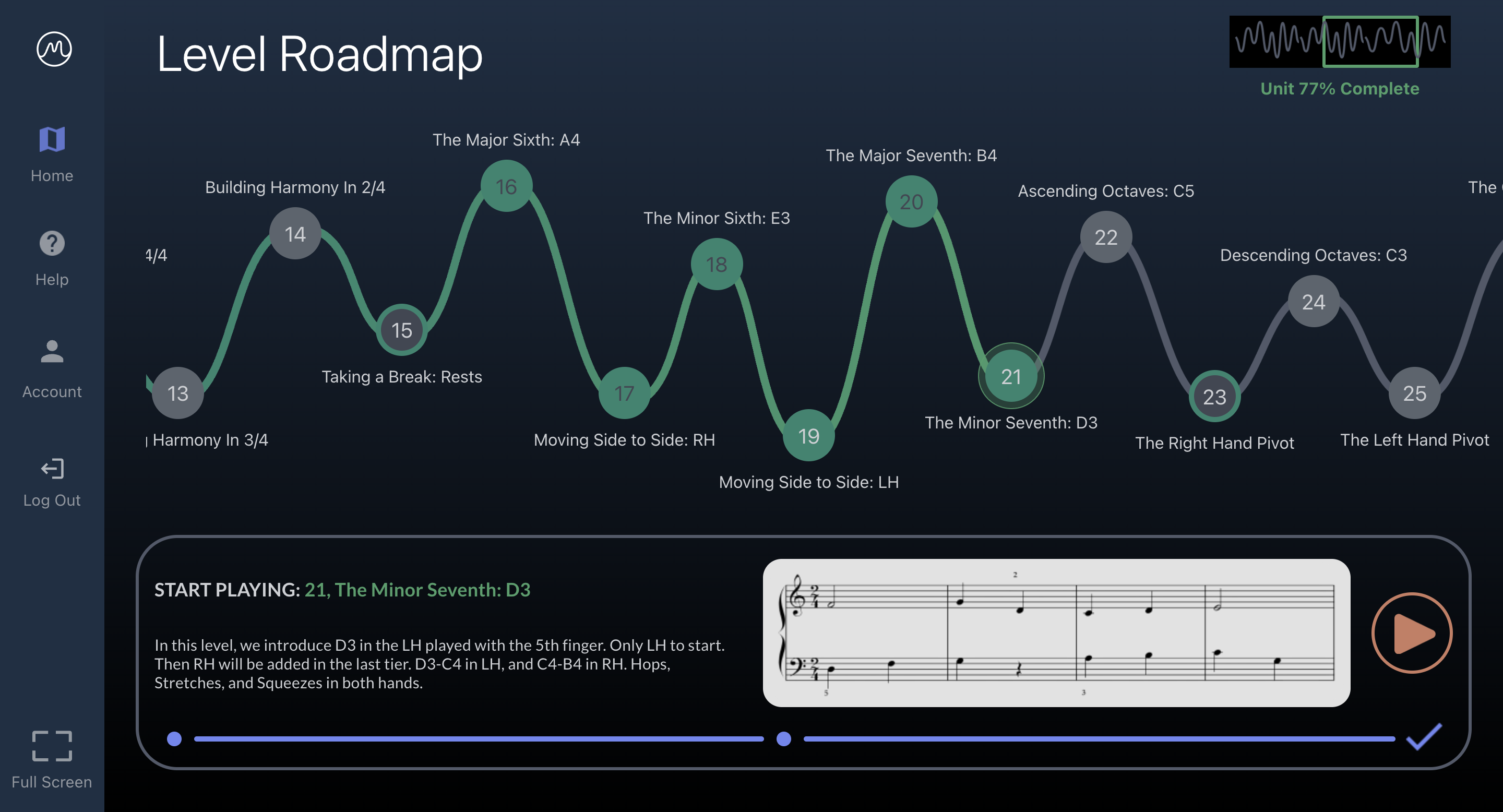
How MuseFlow Fits In
MuseFlow is a piano education program that encourages Flow State and sight reading through constant music variation. The system offers an alternative to the high-pressure classical training that can be healthier for your nervous system and reduce the risk factors associated with focal dystonia.
- Variety: The focus on sight reading means that you’ll be playing songs on first sight. MuseFlow generates an indefinite amount of music so you’ll always have new-to-you pieces to play. This helps your brain build flexible motor programs and strengthen generalizable coordination.
- Flow State: This is antithetical to overthinking and micromanaging. Encouraging a constant state of creative flow with MuseFlow’s gamified system will help reduce the cognitive motor supervision common with musicians with focal dystonia.
- Clear, Attainable Goals: MuseFlow sets clear, attainable goals through incremental learning and continuous music at your skill level. High-pressure perfectionism is replaced by progress-oriented practice and positive reinforcement to create a more sustainable, low-stress improvement. There’s no incentive to push yourself past your skill level and take on more than your nervous system can handle.

Conclusion
If left unchecked, focal dystonia can threaten to derail musicians’ careers. So it’s worth considering how we can reduce the possible risk factors in our music education.
It’s important to note that specific training methods can’t treat focal dystonia or guarantee you won’t develop it. Some people have genetic predispositions and prior injuries that make them more vulnerable to developing the disorder than others. But by focusing your music education around variation, flow, and positive reinforcement, you can support healthier motor learning principles.
And here’s the cool thing about ditching repetitive perfectionism…it can also make learning the piano a lot more fun.


.jpg)